 INR
🌐 Introduction
Radio broadcasting has evolved significantly over the years. From traditional analogue transmission to modern digital broadcasting and internet-based audio streaming, technology has transformed the way radio programmes reach listeners.
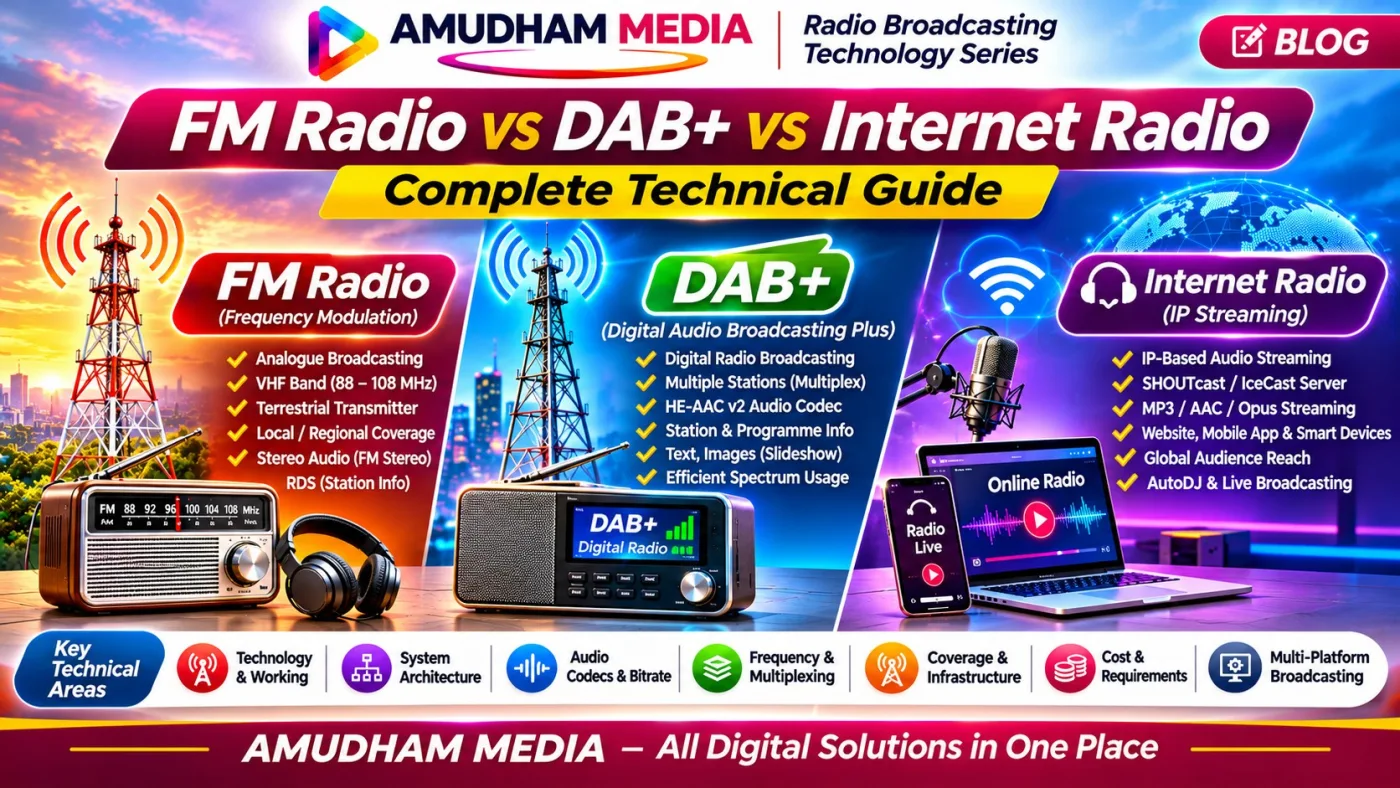
Today, three major technologies are used for radio broadcasting:
📻 FM Radio: Analogue Terrestrial Broadcasting.
📡 DAB+: Digital Terrestrial Radio Broadcasting.
🌍 Internet Radio: IP-Based Audio Streaming.
Although all three technologies deliver radio programmes, their transmission methods, audio processing, infrastructure, receiver requirements and coverage systems are different.
In this article, AMUDHAM MEDIA explains how these technologies work, their system architecture, required equipment, audio encoding, technical characteristics and broadcasting methods.
1. 📻 FM Radio – Analogue Broadcasting Technology
What Is FM Radio?
FM stands for Frequency Modulation.
FM Radio is an analogue terrestrial broadcasting technology. It transmits audio by changing the frequency of a radio-frequency carrier signal according to the original audio signal.
Radio programmes are produced in a studio, processed through broadcast audio equipment and sent to an FM transmitter. The transmitter converts the audio information into an RF signal and broadcasts it through an antenna.
Listeners receive the signal using an FM-compatible radio receiver.
⚙️ How FM Radio Works
The FM broadcasting process includes:
🎙️ Audio Production: Music, news, interviews and programmes are produced in the radio studio.
🎚️ Audio Processing: Audio levels and dynamics are controlled.
🔊 Stereo Encoding: Left and right audio channels are prepared for stereo transmission.
📡 Frequency Modulation: Audio information modulates the frequency of the carrier signal.
⚡ RF Amplification: The transmitter amplifies the signal to the authorised operating power.
📶 Antenna Transmission: The antenna radiates the signal across the intended coverage area.
🎧 Radio Reception: FM receivers tune to the assigned frequency and reproduce the audio.
FM Radio System Architecture
Studio → Audio Processor → Stereo Encoder → FM Exciter → RF Power Amplifier → Antenna → FM Receiver
🛠️ Equipment Required for FM Broadcasting
Radio studio equipment
Microphones and audio mixer
Broadcast audio processor
Stereo encoder
FM transmitter or exciter
RF power amplifier
Transmission antenna
Feeder cables and RF accessories
Monitoring and measurement equipment
📡 Technical Characteristics
FM broadcasting uses assigned radio frequencies. In many countries, the VHF FM broadcast band is approximately 88–108 MHz, although national allocations can differ.
Coverage depends on transmitter power, antenna height, geographical conditions, terrain, interference and receiver sensitivity.
✅ Advantages of FM Radio
No internet connection required.
Compatible with widely available FM receivers.
Suitable for local and regional broadcasting.
Supports stereo audio.
One transmitter can serve many listeners simultaneously.
⚠️ Limitations of FM Radio
Requires authorised frequency allocation and broadcasting permissions.
Requires transmitter and antenna infrastructure.
Available spectrum limits the number of stations.
Weak signals can introduce noise and interference.
Equipment installation and maintenance involve operating costs.
2. 📡 DAB+ – Digital Terrestrial Broadcasting Technology
What Is DAB+?
DAB+ stands for Digital Audio Broadcasting Plus.
It is a digital terrestrial radio broadcasting technology that distributes audio services and additional information through a shared digital transmission system.
Unlike FM, DAB+ can carry multiple radio services within a shared digital transmission channel called a Multiplex or Ensemble.
DAB+ uses the HE-AAC v2 audio codec and includes error protection for digital transmission.
⚙️ How DAB+ Works
🎙️ Audio Production: Radio stations prepare their programmes.
💻 Audio Encoding: Audio is converted into a supported DAB+ digital format.
📋 Service Configuration: Audio services and associated information are organised.
🔗 Multiplexing: Multiple radio services are combined into one digital multiplex.
📡 Digital Transmission: The multiplex is processed and transmitted through an authorised DAB+ transmitter network.
📻 Signal Reception: A compatible DAB+ receiver detects and decodes the signal.
🔊 Audio Playback: The listener selects a service and hears the programme.
What Is a DAB+ Multiplex?
A multiplex is a digital data stream that carries multiple radio services and associated information.
For example, one multiplex may contain:
🎵 Music Radio
📰 News Radio
🗣️ Talk Radio
🏘️ Community Radio
🙏 Religious Radio
The number of services depends on multiplex capacity, audio bitrates, error protection and configuration.
DAB+ System Architecture
Radio Studios → Audio Encoders → Service Multiplexer → DAB+ Transmission System → Transmitter → Antenna → DAB+ Receivers
🔊 What Is HE-AAC v2?
HE-AAC v2 stands for High-Efficiency Advanced Audio Coding Version 2.
It is the audio coding technology used by DAB+.
It combines:
AAC: Advanced Audio Coding.
SBR: Spectral Band Replication.
Parametric Stereo: Efficient representation of stereo information.
These technologies help encode audio efficiently within the available digital multiplex capacity.
🖥️ Additional Information in DAB+
DAB+ can carry additional information alongside audio:
Radio station names
Dynamic text labels
Programme information
Station logos
Slideshow images
Service information
These features depend on the broadcaster's configuration and the receiver's capabilities.
🛠️ Equipment Required for DAB+ Broadcasting
Radio studio and audio production equipment
DAB+ audio encoders
Service configuration system
DAB+ multiplexer
Digital transmission equipment
DAB+ transmitter
Antenna and RF transmission system
Monitoring equipment
Compatible DAB+ receivers
✅ Advantages of DAB+
Multiple stations can share one multiplex.
Supports digital audio transmission.
Can display text and images on compatible receivers.
Does not require internet access for terrestrial reception.
Multiple broadcasters can share transmission infrastructure.
⚠️ Limitations of DAB+
Requires compatible DAB+ receivers.
Depends on digital transmitter network coverage.
Requires multiplex capacity and authorisation.
Weak digital signals can cause interruptions or loss of reception.
Network planning and infrastructure require technical expertise.
3. 🌍 Internet Radio – IP-Based Audio Streaming Technology
What Is Internet Radio?
Internet Radio is a broadcasting method that distributes audio through an internet connection.
Unlike FM and DAB+, internet radio does not depend on a terrestrial transmitter for online distribution. The station sends its encoded audio to a streaming server, and listeners connect through websites, mobile applications, computers and compatible connected devices.
This allows an online radio station to reach listeners across geographical boundaries, subject to internet availability and streaming access.
⚙️ How Internet Radio Works
🎙️ Audio Production: The radio studio produces music, news and programmes.
🎚️ Audio Processing: Audio is prepared for streaming.
💻 Encoding: Audio is converted into MP3, AAC or another supported format.
🌐 Source Connection: An encoder sends the audio stream to the streaming server.
🖥️ Streaming Server: The server distributes the audio to connected listeners.
📱 Listener Connection: Listeners connect using a website, application or compatible player.
🎧 Audio Playback: The device decodes and plays the received stream.
Internet Radio System Architecture
Studio / Audio Source → Encoder / Source Client → Streaming Server → Internet Network → Website / Mobile App / Radio Player → Listener
🎛️ What Is a Streaming Encoder?
An encoder converts audio into a digital format suitable for internet streaming.
Common audio formats include:
MP3
AAC
Ogg Vorbis
Opus
The selected format must be supported by the streaming server and listener devices.
🖥️ What Is a Streaming Server?
A streaming server receives audio from a source client and distributes it to connected listeners.
Two widely used internet radio technologies are:
SHOUTcast: A streaming server technology used for internet radio distribution.
IceCast: Open-source streaming server software designed to distribute audio and other supported media streams.
🔗 What Is a Mount Point?
In IceCast, a mount point identifies a particular stream endpoint.
Example:
/live.mp3
Listeners can connect to the corresponding stream URL to receive the radio broadcast.
A server may support multiple mount points for different channels, formats or bitrates.
🤖 What Is AutoDJ?
AutoDJ is an automated broadcasting system that plays scheduled audio content without requiring a presenter to operate the studio continuously.
Common features include:
Playlist management
Music scheduling
Track rotation
Programme scheduling
Automated playback
Live DJ switching, where supported
Track metadata updates
AutoDJ helps radio stations maintain scheduled and continuous broadcasting.
🛠️ Equipment and Software Required
Computer or broadcasting workstation
Microphones and audio mixer
Audio processing software
Broadcasting encoder
SHOUTcast or IceCast streaming server
Internet connection
Website with an integrated radio player
Android or other mobile radio application
Server monitoring and backup arrangements
✅ Advantages of Internet Radio
Potential to reach international audiences.
No terrestrial transmitter required for online distribution.
Website and mobile application integration.
Supports live programmes and AutoDJ.
Flexible audio formats and bitrates.
Listener statistics through supported platforms.
⚠️ Limitations of Internet Radio
Requires internet connectivity.
Mobile listeners consume data.
Playback can buffer when network conditions are poor.
Server capacity and bandwidth must be planned.
Requires server maintenance and monitoring.
Copyright and applicable content licensing requirements must be considered.
4. 📊 Technical Comparison – FM vs DAB+ vs Internet Radio
| Feature | FM Radio | DAB+ Radio | Internet Radio |
|---|---|---|---|
| Technology | Analogue | Digital terrestrial | IP streaming |
| Internet required | No | No | Yes |
| Transmission | FM transmitter | Digital transmitter | Streaming server |
| Receiver | FM radio | DAB+ receiver | Internet device |
| Multiple services | Separate frequencies | Multiplex | Online streams |
| Audio processing | FM processing | Digital encoding | Streaming encoding |
| Audio format | Analogue FM | HE-AAC v2 | MP3, AAC, Opus |
| Extra information | RDS support | Text and images | Website and app data |
| Coverage | Transmitter-dependent | Network-dependent | Internet-dependent |
| Mobile data | Not required | Not required | Required on mobile internet |
5. 🎚️ Audio Encoding, Codecs and Bitrate
Audio encoding is an important part of digital broadcasting.
A Codec is a technology used to encode and decode audio.
FM Audio
FM transmits an analogue representation of the audio signal through frequency modulation.
DAB+ Audio
DAB+ uses HE-AAC v2 to encode audio into digital services within the multiplex capacity.
Internet Radio Audio
Internet radio supports several audio formats depending on the encoder, server and player.
Examples include:
MP3 – 128 kbps
MP3 – 192 kbps
MP3 – 320 kbps
AAC – Supported bitrates
Opus – Supported bitrates
These are example configurations, not guaranteed quality levels.
What Is Bitrate?
Bitrate describes the amount of encoded data transmitted per second. It is commonly measured in kilobits per second (kbps).
Examples:
64 kbps
128 kbps
192 kbps
320 kbps
Higher bitrate generally requires more network capacity. However, bitrate alone does not determine sound quality. Codec efficiency, encoder settings and source audio quality also matter.
6. 📡 Frequency, Bandwidth and Multiplexing
Frequency
Frequency describes how many cycles a signal completes per second. It is measured in Hertz (Hz).
FM uses assigned radio frequencies. DAB+ uses designated digital broadcasting frequency blocks.
Internet radio does not use a terrestrial broadcast frequency for the stream itself; it uses internet addressing and data transport.
Bandwidth
Bandwidth describes a frequency range or available data capacity, depending on the context.
In terrestrial broadcasting, it is important for spectrum planning. In internet streaming, it affects how many simultaneous streams can be delivered reliably.
Multiplexing
Multiplexing combines multiple services or data streams into a shared transmission channel.
It is a central feature of DAB+.
Internet radio servers also distribute streams to multiple listeners, but this is different from DAB+ radio-frequency multiplexing.
7. 🗼 Transmitters, Antennas and Streaming Servers
FM Transmitter
Generates the RF signal carrying the station's audio and sends it to an antenna system.
DAB+ Transmitter
Broadcasts the digital multiplex generated by the DAB+ transmission system.
Antenna System
Radiates terrestrial radio-frequency energy into the intended coverage area. Antenna design, height, direction and installation conditions affect coverage.
Internet Streaming Server
Receives encoded audio from a source client and distributes it to connected listeners over the internet.
Unlike terrestrial transmitters, it does not directly radiate an RF broadcast signal through an antenna.
8. 📶 Signal Reception and Listener Connectivity
Each technology uses a different reception method.
FM: The receiver tunes to an assigned frequency and demodulates the FM signal.
DAB+: The receiver detects the digital multiplex, decodes the selected service and plays the audio.
Internet Radio: The listener's device connects to a stream URL, receives encoded audio data and decodes it for playback.
Internet playback may be affected by latency, buffering, packet loss and connection instability.
Terrestrial reception may be affected by weak signals, interference and physical obstacles.
9. 🌐 Coverage and Network Infrastructure
FM Coverage
Depends on transmitter power, antenna height, terrain, frequency allocation and receiver conditions.
DAB+ Coverage
Depends on the digital transmitter network, frequency planning, multiplex configuration, terrain and receiver sensitivity.
Internet Radio Coverage
Depends on internet connectivity, server availability, network routing, bandwidth and applicable territorial restrictions.
An online station can reach listeners internationally without having terrestrial broadcasting coverage in every country.
10. 💰 Broadcasting Costs and Operational Requirements
The cost of operating a radio station depends on its location, audience size, infrastructure, equipment and applicable permissions.
| Requirement | FM | DAB+ | Internet Radio |
|---|---|---|---|
| Studio | Required | Required | Required |
| Audio processing | Required | Required | Required |
| Terrestrial transmitter | Required | Required | Not required |
| Antenna system | Required | Required | Not required |
| Multiplexer | Not normally required | Required | Not required |
| Streaming server | Optional | Optional | Required |
| Website | Optional | Optional | Recommended |
| Mobile app | Optional | Optional | Optional |
| Spectrum authorisation | Applicable | Applicable | Different regulatory framework |
Terrestrial broadcasting requires appropriate spectrum access and broadcasting authorisations. Internet radio operators must also check applicable laws, music licensing and content obligations.
11. 🔄 Multi-Platform Radio Broadcasting
A radio station can distribute the same programme through more than one broadcasting technology. This is known as Multi-Platform Broadcasting.
For example, a radio organisation may:
Broadcast locally through an authorised FM transmitter.
Distribute its service through an authorised DAB+ multiplex.
Stream online through SHOUTcast or IceCast.
Provide a website radio player.
Offer an Android application.
Each platform requires its own technical configuration, infrastructure and applicable permissions.
A common studio audio source can feed different distribution systems through suitable audio routing and encoding equipment.
12. 🖥️ Internet Radio Streaming Architecture – Practical Example
Consider an online radio station using IceCast.
Step 1: A presenter speaks into a studio microphone.
Step 2: The audio mixer sends programme audio to a computer.
Step 3: Broadcasting software or an encoder converts the audio into a supported streaming format.
Step 4: The source client connects to the IceCast server using the server address, port, source credentials and mount point.
Step 5: IceCast distributes the stream to connected listeners.
Step 6: Listeners open the stream through a website player, Android application or compatible media player.
When AutoDJ is configured, scheduled playlists can also be broadcast automatically.
13. ⚠️ Technical Challenges in Radio Broadcasting
Every broadcasting technology has operational challenges.
FM Broadcasting
RF interference
Antenna installation issues
Transmitter maintenance
Frequency coordination
Coverage planning
DAB+ Broadcasting
Multiplex configuration
Digital coverage planning
Encoder and transmitter compatibility
Receiver compatibility
Network synchronisation and monitoring
Internet Radio
Streaming server downtime
Insufficient bandwidth
Audio buffering
Source connection failures
Incorrect encoder configuration
Metadata problems
Listener capacity planning
Regular monitoring, reliable infrastructure and backup arrangements help reduce service interruptions.
14. 📜 Regulatory and Licensing Requirements
Radio broadcasting is subject to national and regional regulations.
FM and DAB+ terrestrial services generally require appropriate spectrum authorisation, transmission permissions and compliance with technical broadcasting standards.
Internet radio may follow a different regulatory framework depending on the country and type of service.
Broadcasters must also consider music copyright, performance rights and other content licensing obligations.
In India, consult the relevant government and regulatory authorities before planning a terrestrial broadcasting service. Do not assume that a digital broadcasting frequency or DAB+ multiplex is automatically available.
📝 Conclusion
FM Radio, DAB+ and Internet Radio are three different technologies used to distribute audio programmes.
📻 FM Radio uses analogue frequency modulation and terrestrial transmitters.
📡 DAB+ uses digital audio encoding and multiplexing to deliver multiple radio services through a terrestrial digital broadcasting network.
🌍 Internet Radio uses IP-based streaming servers to distribute encoded audio to internet-connected devices.
Each technology has its own architecture, equipment requirements, reception methods and operational considerations.
Understanding these systems helps broadcasters plan their technical infrastructure and select suitable distribution methods for their intended audiences.
🏢 AMUDHAM MEDIA – All Digital Solutions in One Place
AMUDHAM MEDIA provides digital media and online radio technology solutions, including:
📡 SHOUTcast Radio Hosting
🌐 IceCast Streaming Server
🎛️ Centova Cast Control Panel
🤖 AutoDJ and 24/7 Radio Automation
💻 Online Radio Website Development
📱 Android Radio Application Development
🔊 Radio Streaming Setup
🖥️ Website Hosting
🛠️ Technical Support
Planning to launch your own online radio station?
Contact AMUDHAM MEDIA to explore online radio hosting, streaming, website development and Android application solutions.
AMUDHAM MEDIA – Your Digital Radio Solutions Partner.